

How to Find the Right Dissociative Disorder Therapist for Your Needs
August 24, 2026
How to Recognize Progress During Trauma Therapy
September 8, 2026
Quick AnswerCouples therapy gives partners an expert space to slow down, listen from a different angle, and understand what’s been pulling the relationship apart. With the right therapist, couples counseling in Columbus can help partners rebuild trust, improve communication, and feel emotionally close again after a rough patch. |
In every relationship, it’s common to go through seasons where every partners feel more like roommates than a team. Extended hours, unresolved past arguments, or simply drifting apart over time can leave two people who once loved each other feeling distant.
That distance doesn’t mean the relationship has broken apart. It typically means something has gone unspoken for way too long. This is where couples counseling in Columbus steps in to help. It gives both partners space to say what they’ve been holding back for a long time and start finding their way back to each other.
What Happens Inside Couples Therapy
Couples therapy is a type of guided counseling in which both partners work with an experienced therapist to explore relationship patterns, improve communication, and address issues that are slowly driving them apart. Sessions are typically collaborative, structured, and focused on long-term, practical change.
Most couples therapy sessions focus on a couple of main areas, including:
- Communication patterns and listening habits
- Unresolved conflict or resentment
- Trust and emotional safety
- Intimacy and connection
Couples Therapy Outcomes Post Treatment
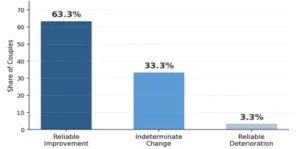
Source: Journal of Education and Health Promotion (NIH), RCT on integrative behavioral couple therapy using clinical significance approach.
These areas notably overlap, as a breakdown in one can affect the others. That is why therapists look at a relationship as a whole, not an isolated issue. Every relationship is different, so couples therapy is rarely one-size-fits-all. A seasoned therapist will align their approach with what each couple really needs.
The Ways Couples Therapy Helps You Reconnect
Here are a couple of specific approaches couples therapy uses to help partners reconnect and feel like a whole new team again.
Learning to Talk Without Walls Going Up
Most couples stop talking to each other before they stop living together, and they stick to surface-level conversations. Therapy builds a space where both partners can explain what they really feel without the conversation turning into a fight.
What Better Communication Looks Like
- Listening without planning a rebuttal
- Naming feelings instead of blame
- Slowing down before reacting
- Checking in regularly, not just in crisis
Once partners feel really heard, small daily conversations start to feel less like a fight and more like a chance to reconnect.
Working Through Old Hurts Together
Unresolved pain from the past, whether from the current relationship or earlier experiences, can shape how partners react to each other. Therapy offers space to couples to process the pain instead of carrying it around like a burden and building an argument.
Signs Old Pain Is Still Present
- Overreacting to small triggers
- Avoiding certain topics entirely
- Feeling defensive before anything is said
For a few couples, this overlaps with individual healing. This is where relationship sessions get combined with trauma recovery therapy that helps both partners to show up to the relationship feeling steadier instead of reactive.
Finding Healthier Ways to Handle Conflict
Every couple argues, but how those arguments unfold makes all the difference in whether closeness grows or fades. Therapy helps partners recognize their conflict patterns and replace old habits with responses that actually resolve things.
Common Conflict Patterns Therapy Addresses
- Raised voices or shutting down completely
- Repeating the same argument on a loop
- Bringing up unrelated past issues
- Walking away without resolving anything
When frustration keeps boiling over into the same fights, counseling to manage anger in relationships can help both partners pause, cool down, and respond in ways that bring them closer instead of further apart.
Rebuilding Trust One Step at a Time
Trust does not come back overnight, especially after a breach like infidelity, dishonesty, or broken promises. Therapy offers a structured way to rebuild it gradually, through consistency, honesty, and small proven moments over time.
Steps That Support Rebuilding Trust
- Consistent follow-through on small promises
- Transparent, honest conversations
- Patience from both partners
- Rebuilding at a pace that feels safe
Working with a professional gives structure to this process, and couples counseling for partners rebuilding trust often makes the difference between slipping back into old patterns and actually moving forward.
Protecting Your Connection Going Forward
Closeness is not something couples build once and then keep forever without effort. Therapy can also help partners build habits and checkpoints that protect their connection long after formal sessions end.
Habits That Help Protect Closeness
- Regular check-ins about the relationship
- Addressing small issues before they grow
- Making time for connection, not just logistics
Many couples find that returning for preventive couples counseling every so often, even when things feel steady, helps them catch small issues before they turn into bigger ones.
Common Approaches Used in Couples Therapy
The table below offers a quick look at common approaches therapists may use.
|
Approach |
Primary Focus |
Often Used For |
|
Emotionally Focused Therapy (EFT) |
Emotional bonding and attachment |
Reconnection after distance or conflict |
|
Gottman Method |
Communication and conflict patterns |
Building shared understanding |
|
Cognitive Behavioral Couple Therapy |
Changing unhelpful thought and behavior patterns |
Reducing repeated conflict |
|
Imago Relationship Therapy |
Understanding childhood-rooted relationship patterns |
Deepening empathy between partners |
|
Integrative Behavioral Couple Therapy |
Balancing acceptance and change |
Long-standing, hard-to-resolve conflict |
Start Rebuilding Your Connection Today
Every relationship has rough patches, and reaching out for support is not a sign of failure; it is a sign that the relationship still matters to you. Permit yourselves to try, even if things feel uncertain or a little awkward right now.
Columbus Care Center offers experienced couples therapy in a supportive, judgment-free space designed to help partners reconnect. Book a session today and take the first step toward feeling close again.
Frequently Asked Questions
How many sessions does couples therapy usually take?
It varies by couple, but many start noticing meaningful shifts within eight to twelve weekly sessions of steady, consistent work.
What if only one partner wants to attend therapy?
Some therapists still offer helpful guidance to one partner, though real change usually happens faster once both partners choose to participate.
Can couples therapy help if we are not married?
Yes, couples therapy works for any committed partnership, married or not, since the same core relationship skills apply either way.


